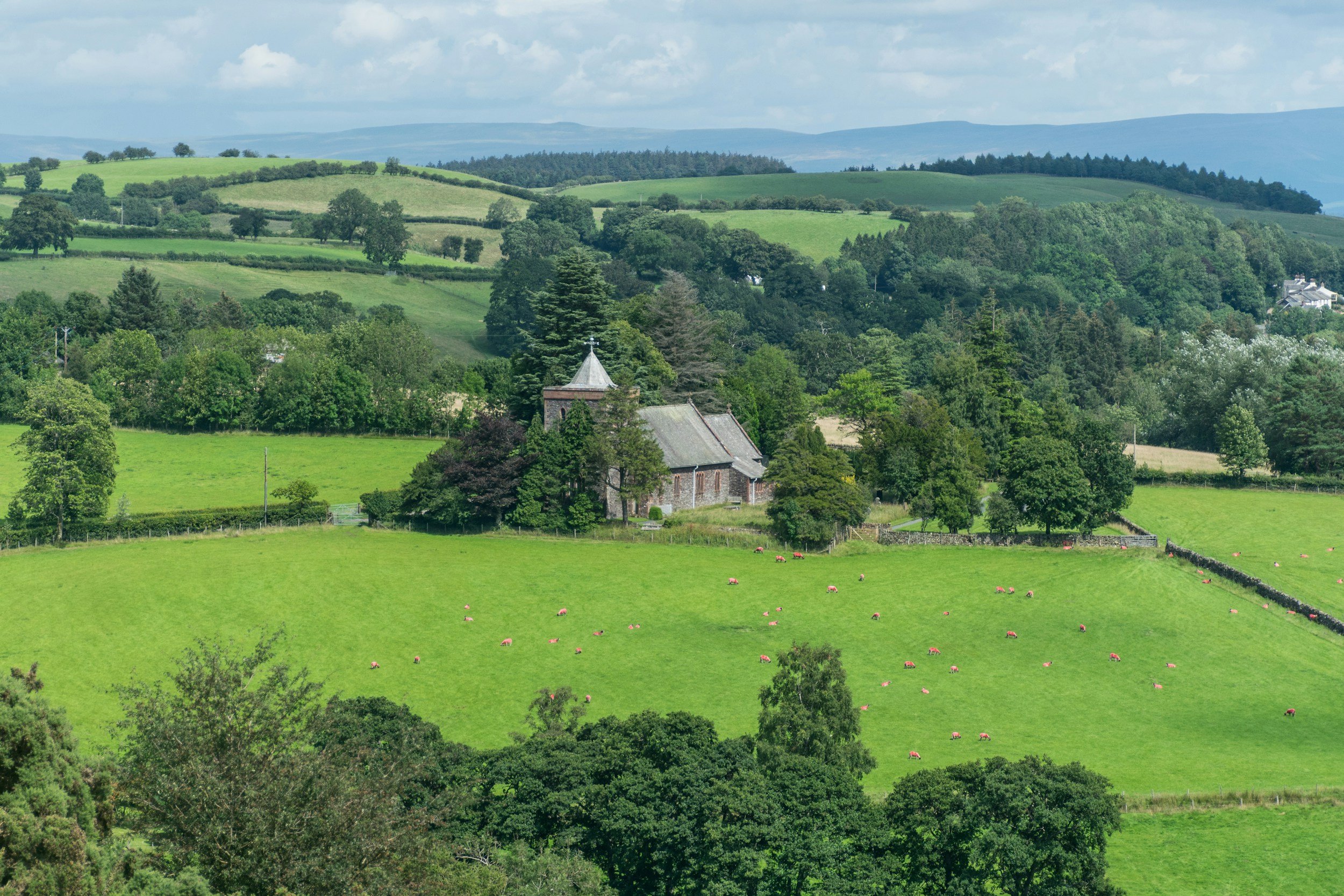
Springtime at Black Down
“Well, it looks like you are the only Jew in this car.”
Judith was sitting across from him in the dimly lit train car as the couplers engaged and the car lurched forward in a squeaky creep out of Paddington station. David was a lapsed Catholic. She was a Reformed Jew. They had been a couple for almost a year. She sighed and rolled her eyes. “Why would you say that?”
“Everyone else is blond or redhead.”
“You think that Jews can’t be blond or redhead?”
“At the synagogue everyone seemed…”
“Swarthy?” She cut him off. “God you are such a country bumpkin sometimes. We come in all shapes and sizes. Maybe this is another train car full of Jews for all you know.” Her eyes flashed. He remembered the stories she told him in the first weeks after they met about her grandparents’ death in Poland. He looked around the rocking train car. Faded red siding, vinyl tables between bench seats, dirty carpet. It was about half full. They used to laugh about what their respective parents would think if he showed up at her apartment in Manhattan or she visited him in Wisconsin.
“I’m sorry. That was stupid. I was just wondering if our baby might have blond hair or dark hair.”
“It’s not a baby. It’s a cluster of cells. I don’t want to fight about this again.” Judith loved David and wanted to have a child one day. But not today. Not when she was still a child herself, still finding her own way in a new world.
Judith turned her head and looked out the window. She watched a border collie circle a herd of sheep. The dog pushed them in a panicked, writhing ball into metal pen. One by one, they were forced into a squeeze chute. Metal bars clamped their necks as they were sheared and sent bald and bawling into a green pasture.
“I’m sorry.” David said.
“For Christ’s sake David! Stop apologizing. It’s nobody’s fault. “
“We were so careful,” he said.
Judith let out a long sigh. “Not careful enough obviously,” she said. “Remember Grenada? You were eager enough when you were the Virgin David.” Her sarcasm surprised both of them and settled on the table between them.
His cheeks flushed and he looked down. She was his first love and his first time. She was brilliant, experienced, and beautiful. She had been so kind as he fumbled his way through those first nights. First unable. Then too fast. And now, this. She reached across and took his hand.
“I love you,” she said. “Please help me through this.”
He nodded. “I love you too.”
They held hands until one track became two, and then four, as the train slowed through dingy, industrial buildings which bordered the tracks, then hissed to a stop. He squeezed her hand again as she hopped from the train car onto the platform. It was the last week in March, but the wind felt cold. Low, gray clouds rolled against green hills.
“Black Down Nursing Home.” he said. “I wonder why they call it that.”
“Shame,” she said.
Black Down Nursing Home was a fifteen-minute walk from the train station. The town was a small, three or four street neatly cared for shamble of streets in the English countryside. They walked past two pubs, a bakery and butcher shop. Skinned chickens and ducks hung stiff and pale in the butcher shop window. White rows of residential flats lined the small streets. They saw the nursing home as they walked the narrow road out of town; two stories of red brick with big windows, built against the side of a hill. They walked ahead, holding hands, leaning forward, shoulder to shoulder. Grim, against a spitting wind.
“Jesus Christ,” she said as they walked through the glass entry doors and stood in the lobby. “It really is a nursing home.”
To the right of the lobby was a dining/social room framed by large bay windows. A garden filled with purple Irises pushed against windows and yielded to a large lawn, anchored by a small pond, where white swans swam and dipped their long necks.
There were twenty or thirty residents in the main room. Some pushed walkers, some were in wheelchairs. Some sat silently staring. Four women played cards at a table near the bay window. White-coated attendants wandered through the room picking up dishes, rearranging lap blankets, and sometimes talking with the residents.
“Full-service mortality,” David said, “conception to death.”
Judith forced a thin smile and a half laugh as she watched the geriatric residents mill about in the large room.
“You must be looking for the clinic.” They both turned and looked at the stout, friendly, gray-haired woman behind the front desk. “That’ll be to the left dear, don’t mind the nursing home, Health Services needed a clinic, and we had the space. Just through those doors.” She pointed to a set of double doors.
The abortion clinic waiting room was an austere square room with gray carpet and eight plastic, unmatched chairs. A young woman sat at a desk behind a Dutch door. There were four other women in the waiting room, two with partners and two alone. All four looked down when Judith and David walked in. No one was speaking. Judith filled out a thick stack of forms and waited to be called.
“She will need to spend the night,” the nurse said when Judith’s name was finally called.
They had not planned on that. David had no place to stay.
“I’ll be fine to leave,” said Judith.
The nurse gave them both a long, sympathetic look. Two nineteen-year-old college kids in a foreign country. “Sorry love, no exceptions.” David ran his hand through Judith’s hair and kissed her cheek.
“It’s okay, I’ll be fine.” They wrapped a purple band around her right wrist. It was the exact shade of the Irises in the garden. David squeezed Judith’s hand before she sat down in a wheelchair and disappeared down a hallway.
It was only mid-afternoon, but it felt much later to David. The air smelled wet and heavy. He stood in the half-circle driveway and watched through the nursing home windows as the residents began gathering for afternoon tea. It started to rain again. He listened to the rain splat against the gravel stones of the driveway. Crows called in the bare trees that lined the road to the nursing home. Low stone walls bordered fields where cows grazed. With no other place to go, David began walking back to the village.
He was halfway down the main street when he saw a church sitting at the end of one of the side streets. He walked towards it. The large, tablet-shaped oak doors at the front of the church were unlocked. He couldn’t remember that last time he had been in a church. He and Judith had been going to the synagogue together for the past 6 months. The interior of the church was lit only by scallop lights on the two outer walls and a few votive candles. The stations of the cross lined the walls. He peeled off his wet jacket and tossed it in a back pew, then walked toward the front of the church and sat down. The alter was draped in white. To the left of the alter was a gold baptismal font with a base of carved angels. Fresh flowers were set in vases at the foot of a statue of the Virgin in an alcove to the right of the main alter. Her face was lit by small floodlights shining up from the floor. He remembered that Easter Sunday was next weekend. It was the Vernal equinox. Signs of spring were everywhere.
David stood and walked to a wrought-iron rack of votive candles, lifted a new candle from a box, lit it against another candle, and set it in the rack. He knelt with his face in his hands. He thought of them sitting on the edge of their bed with the white plastic pregnancy test. At first, they just saw the vertical control line and they both breathed together. Then, as if in a dream, another line formed and there was the plus sign, the sign of the cross, bright, and black in the bedroom light. Judith had burst into tears.
He looked up at the crucifix hanging high above the alter, face twisted in pain, and walked back to the pew. He sat, still and staring, until he heard footsteps echoing toward him along the tile aisle in the center of the church. The priest wore a black robe and a white collar. He smiled down at David.
“I’m sorry Father, I’ll go.”
As David moved to stand, the priest put a hand on his shoulder.
“Stay and rest,” he said.
“Father,” David asked, “when does a soul enter a body?”
The priest looked away and off towards the altar, then turned back to David. “Our souls are eternal and are always with us, just as God’s grace is also always with us.”
David listened to the footsteps again as the priest receded into darkness. He tried to pray but felt empty. Finally, he lay down, and slept. In his dreams, a child came to him and put a hand on his forehead.
David woke early, his back and shoulders were stiff from the hard, wooden pew. Soft light spilled in from the stained-glass windows. A kaleidoscope of colors drifted on the tiled floor. David put on his still-damp jacket and walked back to Black Down.
He was waiting when they wheeled Judith in from the surgical center. She smiled sweetly at him. Her hair spilt across her shoulders. Dark circles framed her eyes. David thought that she had never looked so beautiful. He kissed her on the lips. “How do you feel?” he said.
She held up a bag and tried to look brave. “Sore, tired, sad. They say I’ll need these giant pads for a week or two.”
They walked two feet apart and held hands as they slowly made their way back to the train station. David carried their daypacks and the bag of sanitary pads. The blacktop was slick and shiny in the morning light.
The rain started again as the train picked up speed. Judith folded her arms across her stomach, leaned her head against the window, and closed her eyes. David watched her blurred reflection in the window. Wind-driven drops streaked the window like tears. Outside, he watched an old man with a silver pail under one arm herd black and white cows to a milking barn. A tractor plowed a fallow field. Three children raced in the ditch next to the train, laughing and pulling their arms up and down, trying to get the engineer to blow the horn.
Inside, the train pulsed on the tracks like a heartbeat.